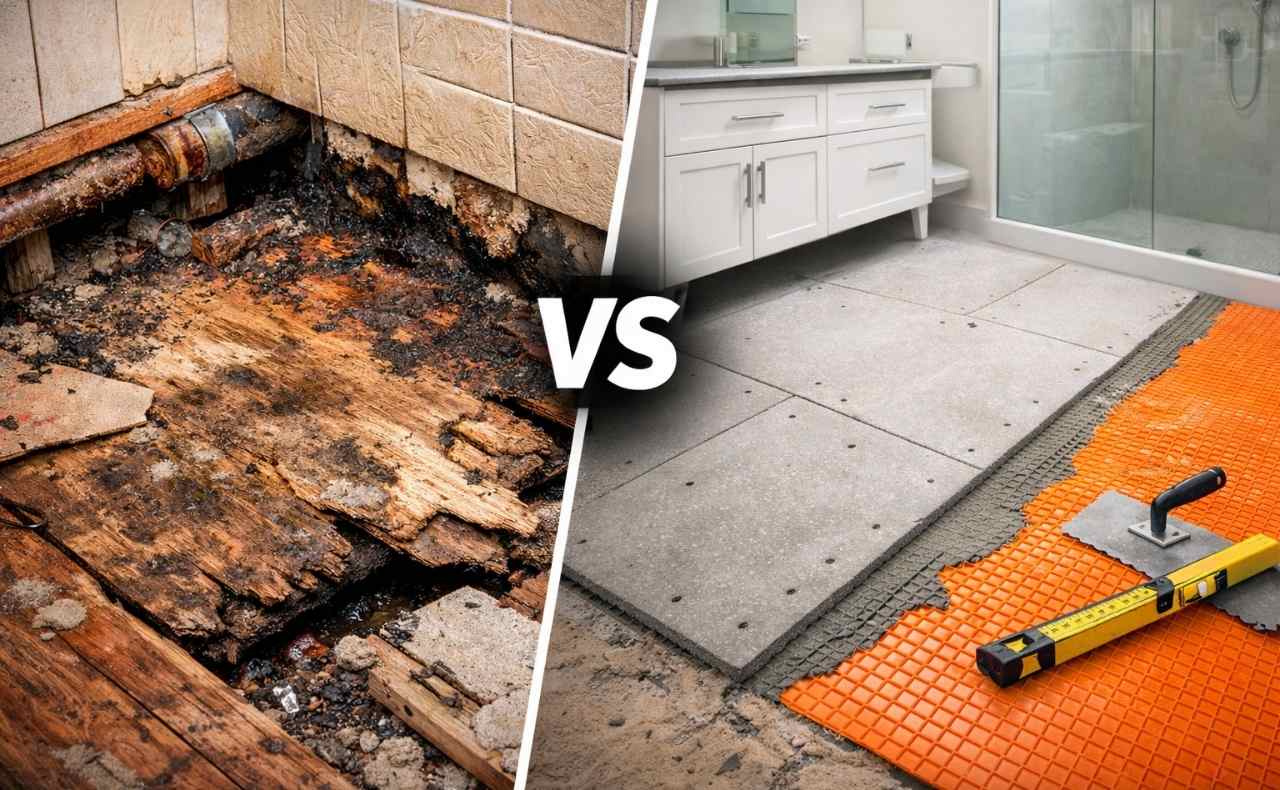

We at RenosGroup.ca believe in a “foundation-first” approach to home renovation. The subfloor is the most important part of a kitchen or bathroom project, not the cabinetry, backsplash, or hardware.
One of the most frequently asked questions we receive is whether homeowners can simply use plywood or OSB (Oriented Strand Board) as a subfloor in these wet areas. While wood is a staple of residential construction, it is fundamentally ill-suited for the unique environment of a kitchen or bathroom. Here is an educational look at why we recommend moisture-stable alternatives and why avoiding wood subfloors is essential for the longevity of your home.
1. The Science of Wood and Moisture
To understand why wood fails in wet zones, we have to look at its biological composition. Wood is an organic, “living” material. Even after it has been kiln-dried and processed into construction-grade sheets, it remains hygroscopic. This means it will always try to balance the amount of moisture in the air around it.
The Cycle of Expansion and Contraction
Wood is pretty stable in a dry place, like a hallway or bedroom. However, bathrooms and kitchens are subject to constant fluctuations in humidity and direct liquid exposure.
-
Expansion: When wood absorbs water—whether from a steamy shower, a mopping bucket, or a dishwasher leak—the cellulose fibers swell.
-
Contraction: As the wood dries, it shrinks back down.
This movement poses a significant challenge to a high-quality renovation. Most modern kitchen and bathroom floors utilize tile, stone, or luxury vinyl. These materials (and the grout or adhesives holding them) are rigid. When the subfloor beneath them is constantly expanding and contracting, it creates mechanical stress. Over time, this stress shows up as cracked grout lines, tiles that have “popped” or come loose, and even cracks in the tiles themselves.
Explore top flooring trends for stable kitchen and bathroom surfaces here
2. The Threat of Structural Rot and Mold
The primary danger of using wood in wet areas isn’t just that it moves; it’s that it decays. Wood is organic matter, which means it provides a food source for fungi and mold.
The “Sandwich” Effect
In a normal renovation, a finished floor, like tile or vinyl, is put on top of the subfloor. These finishing materials are usually water-resistant or waterproof. These finish materials are often waterproof or water-resistant. If water finds its way through a failed silicone bead around a bathtub or a minor leak under a kitchen sink, it becomes trapped between the finished floor and the wood subfloor.
Without airflow, the moisture has nowhere to go. This creates a “sandwich” of dampness. In our professional experience at RenosGroup.ca, we have seen countless instances where the top of a tile floor looks perfectly fine, but the wood subfloor beneath it has turned into a soft, pulpy mass. This is called “dry rot,” but it needs moisture to start. When rot starts, it weakens the structure of the floor, which can cause it to sag and make it dangerous to use heavy appliances or bathtubs.
Air Quality and Health
In addition to structural problems, wet wood subfloors are a perfect place for mold to grow. Mold can grow on the subfloor without anyone knowing it for years. The spores eventually make their way into the air in the home, where they could cause breathing problems and allergic reactions. Using an inorganic subfloor gets rid of the food that mold needs to grow.
Learn how to prevent mold after your bathroom renovation here
3. The Specific Problem with OSB and Plywood
Not all wood subfloors are the same, but both common types have their problems when they get wet:
- OSB (Oriented Strand Board): This type of board is made of wax and resin that hold together compressed wood flakes. While it is strong, it is particularly susceptible to “edge swelling.” If the edges of an OSB sheet get wet, they expand and often stay expanded even after they dry. This creates an uneven floor surface that will be visible through your new flooring.
- Plywood: Plywood consists of thin layers of wood glued together in alternating directions. While more stable than OSB, it is prone to delamination. If moisture stays trapped in the layers, the glue fails, and the layers peel apart, causing the floor to lose its load-bearing capacity.
4. Professional Alternatives: What We Use at RenosGroup.ca
As professionals, we prioritize the use of materials specifically engineered for the task at hand. In kitchens and bathrooms, we move away from organic wood and toward inorganic, moisture-stable products.
Cement Backer Boards (CBU)
Materials such as HardieBacker or Durock are the industry standard for a reason. These boards are made of cement, sand, and glass-fiber mesh.
-
Why they work: They are 100% inorganic. If they get wet, they resist rot and swelling and prevent mold growth. They provide a perfectly rigid, flat surface that is ideal for thin-set mortar and tile.
Uncoupling Membranes (Schluter-DITRA)
In high-end renovations, we often utilize uncoupling membranes. These are polyethylene (plastic) mats with a specific grid structure.
-
Waterproofing: They act as a total vapor and water barrier.
-
Movement Management: They allow the subfloor and the tile to move independently. The membrane “uncouples” the movement from the tile, which stops cracks from happening. This condition happens when the house settles or the joists move slightly.
New Composite Boards
Magnesium Oxide (MgO) boards and other new technologies work even better. They are lighter than cement board, but they are just as resistant to water and fire, making them a better base for any kitchen or bathroom design.
See our dream kitchen renovation plans using moisture-proof materials
5. Long-Term Value and ROI
We understand that choosing specialized subflooring materials adds a small cost to the initial budget. However, we always educate our clients on the “Cost of Failure.”
Installing a proper, moisture-stable subfloor is significantly less expensive than a “rip-out.” If a wood subfloor fails due to a leak five years from now, you aren’t just paying to fix the subfloor; you are paying to demo the tile, replace the wood, remediate the mold, and buy all new finish materials.
A renovation should be a one-time investment. By using the correct materials from the start, we ensure that your kitchen or bathroom is built to last for the lifetime of your home.
Check out this complete bathroom ensuite redo with lasting subflooring
Conclusion
At RenosGroup.ca, our goal is to provide a beautiful finish that is backed by sound engineering. Wood is a fantastic building material for many parts of the home, but in the high-moisture environments of kitchens and bathrooms, it simply doesn’t meet the professional standard for longevity. By opting for inorganic cement boards, membranes, and proper waterproofing, you protect your home, your health, and your investment.
Ready to ensure your renovation lasts for years to come? Contact RenosGroup.ca today to discover the best materials for your kitchen or bathroom. You can fill out our online form or call us directly at (613) 727-9427 to schedule your consultation. Let’s build something that lasts.