
By Keith Melanson, RenosGroup
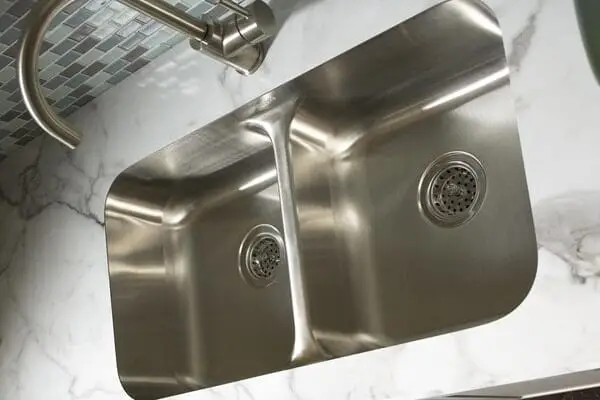
Undermount sinks have become all the rage in today’s age, as they provide a sleek appearance and are easier to keep clean (no ridge means no opportunity for grease and grime to accumulate).
Yet, an undermount sink requires a different type of installation than traditional ‘drop-in’ sinks.
Also, undermount sinks work better with certain materials than others. In particular, solid surface materials work best, as they can support the considerable weight of the sink and your not left with exposed edges of unfinished wood around the sink opening.
Due to their strength and durability, granite, soapstone, and concrete are all perfect countertop material options for undermount sinks.
But what if you have laminate countertops instead? Will you still be able to install a beautiful undermount sink for your kitchen?
The answer is a bit complicated. While possible, it’s a complex job that you should leave to a finish carpenter experienced in building laminate countertops.
If you attempt to install an undermount sink into your laminate countertops by yourself, you could end up costing yourself thousands in repairs.
Read on to learn more about undermount sinks and laminate countertops and how to combine the two successfully.
See Our Professional Renovation Projects in Ottawa
Installing an undermount sink with a laminate countertop requires precision. Unlike stone or solid-surface materials, laminate uses a particleboard or MDF substrate that is highly vulnerable to moisture infiltration. The following steps outline how Ottawa professionals achieve a watertight, structurally sound installation.
- Select a Thin, Laminate-Compatible Sink: Standard undermount sinks are too heavy. Choose a thin-gauge stainless steel or composite sink specifically rated for laminate.
- Precision Cutout: Use a jigsaw with a fine-tooth laminate blade to prevent chipping the surface, which can compromise the seal.
- Seal the Substrate Edge: Apply a continuous bead of 100% silicone waterproof sealant along the entire perimeter of the cutout edge. This is the critical moisture barrier.
- Structural Reinforcement: If needed, install a plywood reinforcement frame beneath the sink to distribute weight across the cabinet box.
- Secure Mounting: Align the sink and install mounting clips and brackets. Drill pilot holes into the reinforcement frame—not directly into the laminate substrate.
- Final Seal & Cure: Apply a second bead of silicone around the interior seam and allow it to cure for a full 24 hours before use.
What are Undermount Sinks?
In general, there are two types of sinks used in kitchens and bathrooms – drop-in sinks and undermount sinks.
The primary difference lies in the installation method.
Drop-in sinks get installed by cutting a hole on top of the counter and dropping the sink in, hence the name.
Undermount sinks, on the other hand, get installed beneath the countertop and are held in place by an extra-strong adhesive and special mounting brackets. For this reason, it’s critical for the material to be robust enough to support the weight of the sink without causing issues.
For an undermount, the sink installs flush into the countertop, not below or above. While this provides a stylish look that’s also easier to clean – it’s what can cause problems with weaker materials, such as laminate countertops.
Strength and stability aren’t the only issues laminate countertops have with undermount sinks, either.
Laminate countertops contain MDF (medium-density fibreboard) underneath, which is extremely sensitive to moisture. If the MDF gets wet, it will ruin your countertops due to warping (foiling your ability to install an undermount sink in the future, too).
So if you’re going to install an undermount sink on a laminate countertop in your kitchen or bathroom, you need to make doubly sure that no moisture can seep through into the MDF.
Why are Undermount Sinks Popular?
In the past, down-in sinks were virtually everywhere due to their versatility and ease of installation.
However, undermount sinks have taken over in recent years due to a variety of attractive benefits they yield to homeowners, including:
- A superior sense of style. Undermount sinks provide a sleek, streamlined look that’s more modernized than a down-in sink. Many homeowners desire undermount sinks for the visual appeal alone.
- They’re more hygienic. Drop-in sinks have the unique disadvantage of having silicone bead seals around the edges. Not only are these unsightly, but they’re breeding grounds for bacteria, as they’re notorious for accumulating grease, grime, and dirt. An undermount sink has no such seal, so they’re a far more hygienic option.
- Clean-up is a breeze. This plays off the previous benefit. Since there’s no seal around the edge, there’s nothing for water/food remaining to get caught on. As such, you can clean your countertops by funneling everything directly into your sink.
- They add counter space. A drop-in sink will take up more counter space, limiting the area where you can prepare food and store appliances. Undermount sinks are far more compact, so you’ll enjoy more counter space as a result.
- You can install the faucet anywhere. On a drop-in sink, the faucet can only go in one spot – in the sink basin. With an undermount sink, you’ll experience full faucet freedom. You can choose to install it on the wall, behind the bowl, to the side, or wherever else you please.
Those are the main reasons why undermount sinks have dramatically risen in popularity in recent years.
Laminate Countertop Concerns
As previously stated, laminate is a weaker material
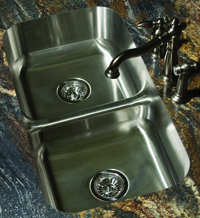
than granite or marble – which is why it has trouble supporting an undermount sink.
So does that mean there’s no hope for laminate countertop owners with their hearts set on undermount sinks?
Not at all, just that there are a few extra steps involved in the process (which will likely require homeowners to rethink their budget).
We can’t stress enough that a complicated job like this is best left to professional contractors like us. Attempting to build your own laminate countertops or install a sink with mounting brackets and glue can end in disaster.
For instance, if you get the particle board wet, it can warp your countertops and ruin them forever.
Frequently Asked Questions: Undermount Sinks & Laminate
Can moisture damage a laminate countertop with an undermount sink?
Yes, if not properly sealed. Laminate countertops use a porous particleboard substrate that swells when exposed to water. Using 100% silicone sealant on all cutout surfaces is non-negotiable to prevent delamination.
How much does it cost to install an undermount sink with laminate in Ottawa?
In the Ottawa market, professional installation typically ranges from $800 to $2,500 CAD, depending on the sink material and whether structural reinforcement is required.
What is the best sealant for undermount sinks on laminate?
Always use a 100% silicone waterproof sealant rated for kitchen and bath. Avoid acrylic or latex caulks, as they lack the flexibility needed for the thermal expansion that occurs around kitchen sinks.
Will an undermount sink work with my existing laminate countertop?
It depends on the condition. If your laminate is already showing signs of swelling or water damage near the existing sink, it should be replaced before attempting an undermount conversion.
Concluding Thoughts: Undermount Sink With Laminate Countertops
In summary, installing an undermount sink on laminate countertops is possible.
While laminate is far from the ideal material to use, it’s still doable with custom laminate countertops and a thin, utterly flat sink.
We’ll be completely transparent…. In many cases, it will be more work and cost than it may be worth for you. If properly installing an undermount sink on your laminate countertops is out of your budget, we can recommend looking for good deals on leftover stone countertop pieces and using a standard unmount sink of your choice. Feel free to contact us or call us at 613-727-9427 for a free in-home consultation on your next renovation in Ottawa
Gallery of manufacturer’s pictures
Website: Karran.com
Link to video on how a stainless steel sink is installed under laminate countertop
Link to video on how a solid surface (acrylic) sink is install under laminate countertop